Professional · Lesson 2 · ~8 min
Fleet Lifecycle Strategy.
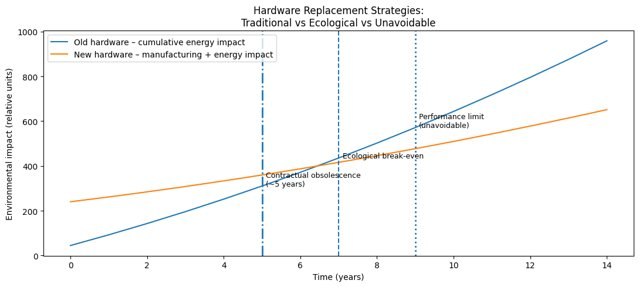
Extending replacement cycles from three to six years on a 100-laptop fleet roughly halves both the hardware budget and the Scope 3 emissions. The hard part is operational, not technical.
This lesson covers what makes a 6-year fleet realistic, the mid-life refresh that makes it possible, and the internal cascade — engineering hand-me-downs to office, office to kiosks — that gets the most service out of every device.

What doubling the cycle actually saves
The math is uncomfortable for vendors
Over six years:
• 3-year cycle: 100 laptops bought in year 0, 100 more in year 3. Total spend: ~€240,000. Total manufacturing CO₂: ~50 tonnes. Operational overhead: two procurement cycles, two deployments, two decommissionings.
• 6-year cycle with mid-life refresh: 100 laptops in year 0. At year 3: replace all batteries (~€60 each), upgrade SSDs where needed (~€80 each), clean keyboards. Total spend: ~€134,000. Total manufacturing CO₂: ~26 tonnes. Operational overhead: one procurement, one mid-life touch, one decommissioning.
That's a ~44 % budget saving and ~48 % carbon saving, before counting the avoided ITAD costs and decommissioning labour. Across an organisation of 1,000+ devices, the numbers become serious money and serious Scope 3 reductions.
3-year cycle vs 6-year cycle, side by side
| Lifecycle | 3-year cycle | 6-year cycle (with refresh) | Difference |
|---|---|---|---|
| Devices procured | 200 | 100 | −50 % |
| Hardware spend | ~€240,000 | ~€134,000 (incl. €14k refresh) | −44 % |
| Manufacturing CO₂e | ~50,000 kg | ~26,000 kg | −48 % |
| Procurement cycles | 2 | 1 | −1 |
| Decommissioning events | 2 | 1 | −1 |
| Mid-life refresh cost | — | ~€14,000 | added |
| Battery refreshes | 0 (replaced wholesale) | 100 at year 3 | added |
| Average user-facing performance gap | — | Negligible for office work (see Foundations Lesson 2) | — |
The performance objection is mostly false. Foundations Lesson 2 showed single-thread CPU performance has only quadrupled in 20 years — most of it before 2018. A 6-year-old business laptop with a fresh battery and SSD is, for everyday office work, nearly indistinguishable from a new one. The case for the 3-year cycle is institutional inertia, not user experience.
Correct.
Not quite — review the section above.
The mid-life refresh — what it actually involves
Year 3 is when you decide whether the fleet survives to year 6
For a typical 100-laptop fleet at year 3:
• Battery replacement for every device with battery health below 80 % (typically ~85 % of the fleet at year 3). Cost: €40–80 per battery in bulk. This single intervention is what makes year 4–6 tolerable; without it users will be unplugging dead laptops every afternoon.
• SSD upgrade or replacement for any device with under 256 GB or showing SMART warnings. Cost: €50–100 per SSD in bulk. New users coming onto the fleet (replacing leavers) get the SSD upgrade pre-deployment.
• RAM upgrade on machines still at 8 GB. By year 3, modern web apps want 16 GB. Cost: €30–60 per machine in bulk.
• Deep clean of keyboards, screens, vents (dust kills cooling). Often the difference between 'old laptop' and 'still feels acceptable' in user perception.
• OS refresh — clean reinstall, fresh image. Removes accumulated software bloat that often gets blamed on hardware aging.
Optional but valuable: replace cracked screens, swap noisy fans, replace worn keyboards, refresh power adapters. Total cost per device: typically €100–200 in bulk. Compare with €1,200 for a new device.
Correct.
Not quite — review the section above.
TCO with a carbon line
What total cost of ownership should actually include
A Green-IT-aware TCO adds a Scope 3 line: an internally-assigned price per kg CO₂e (typically €0.10–0.30 in 2026, rising as carbon pricing tightens). At €0.20/kg, a new laptop adds ~€50 to its true cost (250 kg × €0.20). A refurbished laptop adds ~€10 (avoided manufacturing, only the refurbisher's overhead).
This line item is small but consequential: it makes the case for refurbished-first procurement defensible without requiring sustainability and finance to fight each other. The procurement KPI becomes 'lowest TCO including carbon' rather than 'lowest purchase price', and the answer changes.
Why this matters for the rest of the path
Connecting the dots
That is the topic of Lesson 3 — Repair & Refurbish at Scale: in-house spare-parts stock, mean-time-to-repair targets, manufacturer support deals worth signing, refurbished-first procurement at refresh time.
Replacement strategies: contractual, ecological, unavoidable